

A Sweet, Leafy Embrace

Here I am, relaying the week’s wins to my therapist. With every word, I’m struggling to appear content with myself and comfortable with vulnerability. When I’m done, I fall silent, expecting the glow of her soft, restrained smile of pride to wash over me. But, instead of bathing me in approval, she ducks her head and starts scribbling in her notebook.
I sit frozen as the scritch-scratch of her pen carves a brutal flow of ink between the lines of her notepaper. All of that scritch-scratching layers into a huge ink-blot that builds into a terrifying blossom of judgment in my mind.
When my she realizes I’m no longer talking, my therapist looks up and lances me with a searching glance.
“So that strategy, does it seem to help?” she asks.
I don’t speak immediately. Instead I force my face to relax as I madly sort through possible responses. I strip each response down to its data points, trying to identify how my answers will be catalogued in the library of evidence that is slowly determining my diagnosis.
I choose a gentle, non-defensive head tilt. I hope this tiny motion convinces her that I’m open to being picked apart, flayed and analyzed. I need her to believe that I have nothing to hide.
“Well, it did,” I say. Then I hesitate.
The gauntlet for this battle was thrown down in our prior session. After determining that I was chronically inauthentic, my therapist declared that I needed to learn how to say what needs to be said. She defined the goals: Ask for what I need without fear; and develop a facility with speaking my truth.
After I mentioned my great love for trees, she suggested I begin my authenticity journey by tapping into the power trees. She assured me that tree talking would be an easy entry-point to help me practice open, non-defensive communication. I could not deny that a tree would not judge me. (I was still not convinced that she was not judging me.)
“Okay, tell me how it helped,” the therapist says.
“Oh,” I say, surprised at being asked to talk in therapy.
I quickly sort through my memory, searching for a safe response.
“It helped me…” I pause, my mind spinning. “It helped me learn new things about myself.”
I give her a shaky, hopeful smile, praying that she won’t pry. She gives me an encouraging nod.
“Well, it was just like you said…”
And that is the truth. The tree talking was just as she said it would be—a quiet time to hear a rare sound: me, being authentic out loud.
I tell her how I wandered my neighborhood park, leaving behind the benches and running paths to find a grand oak tucked in a quiet corner. I describe how the branches sheltered me as I unburdened myself and let my voice fly free. I share how it felt to let my emotions and desires linger in the air. My voice trembles with a sense of wonder as I recall how the tree embraced me with a deep sense of peace; how, through tree talking, I discovered the secret of release.
She beams, finally bestowing upon me the gleaming pride I had been craving. In the glow of her approval, I hope my smile radiates honesty. I hope she cannot tell that I am biting back the heart of the story with a duplicitous grin.
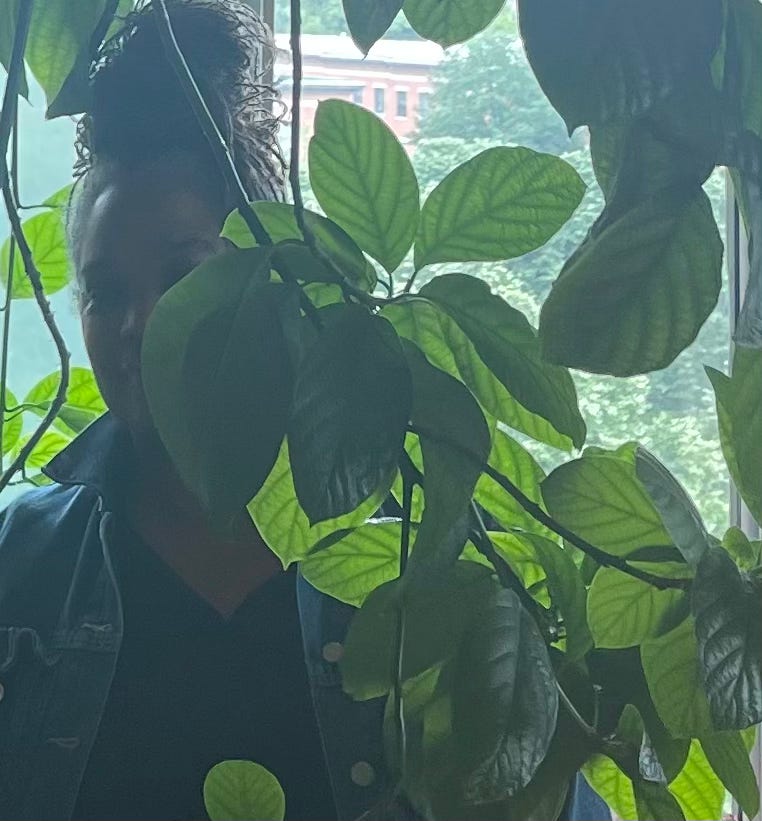
New as we are with each other, I am certain that she does not need to know all. So I don’t confess that my tree talking did not end in the park. Upon my return home, I kicked off my shoes and washed my hands. Having made a steaming cup of tea, I did what I always do to end the day: I skirted around my sofa and crept underneath the branches of my avocado tree. Grown from a pit that I had smuggled back to Brooklyn from Cartagena, it is a living anchor of green happily thriving in my living room; with leaves that brush the ceiling and branches that span wider than the reach of my arms, this tree is a miracle.
As I stood there, enveloped in the avocado tree’s cloud of leaves, a new awareness crept over my skin. If, I thought, I could talk to a tree in the park, could I talk to this tree? This tree that I had grown from seed. Before I could get tripped up on the sanity of talking to a houseplant, I twisted around, looked up at the crown of the tree, and asked, “Can you hear me?”
The avocado tree answered immediately through a string of words that unraveled in my mind.
“I can hear you.”
I stiffened when I heard that. I have always been paranoid that my tech is watching me. I never thought to suspect my houseplants.
“Have you…? Have you been listening to me all this time?”
“What else would I listen to? I listen to you breathe. I listen to you groan. I listen to you cry.”
I was speared by a sudden shame. There wasn’t a lot of things I was good at, but keeping houseplants alive was my gift. I assumed if my plants thought anything of me, they would see me as a goddess—the all-powerful one who provides them with the water they need to survive. It was a gut punch to hear that my avocado plant saw me as a desperate mess.
“Sounds like torture,” I said.
“No,” the plant replied. “Not torture. Your breath speaks a beautiful language. Between your sighs and cries, I learn the secrets of your heart.”
With a yelp, I darted out of the plant’s embrace. I clapped my hands over my mouth and rushed down the hall, questions firing wildly in my mind. I paused to fling a harried peek over my shoulder to make sure the plant had not followed me. Then I slammed the door to my plant-less bedroom and took refuge under a pile of blankets and pillows.
That night, I slept fitfully under a mass of confusion too thick to untangle. The plant’s soft whispers convinced me to brave the living room again. At first, I lingered at a safe distance, but the plant was not swayed. It draped soft questions over my shoulders, and kissed my head with sweet praise. Before I knew it, I was wandering closer as I unearthed secrets that had been locked away for decades. With each overture, the plant welcomed me with open arms; with each answer my restraint slowly dissolved and my fear slipped away.
When the therapist asks me to say more, I describe how tree talking helped me surface memories, transform shame, and embrace my flaws. I do not disclose how I transformed my couch into a bed and slept beside my avocado plant every night. I did not describe the daily unspooling, the waves of emotion that overwhelmed me as I sank into an ocean of unburdening, and an oasis of singing—yes, singing! Tell no one, but when I sing, my plant trembles, joyously shaking its leaves, whispering that it loves not only my breath, but my voice, my heart and my entire being.
Instead of detailing how my avocado plant activated truths I had buried deep inside, I say, “It feels like medicine.” When I add that the tree makes me feel seen and validated, I know my therapist thinks I’m talking about the tree in the park. I know she doesn’t dream that I’ve fallen headfirst into an intimate journey with my avocado plant when I say, “I think I can feel my wounds healing!”
“That is wonderful,” my therapist says. Then she switches to her pushing boundaries voice—it’s firm, yet nonthreatening. “Do you think you could share some of these conversations with a trusted friend or family member?”
I pause, remembering the disappointment each time I tried to connect with friends—the blank stares; the well-meaning, but dispiriting advice; the silence and gaslighting that had smothered any interest I had in authentically connecting with others. In comparison, the conversations with my avocado plant are a balm—the plant pours into me, pointing out virtues I didn’t know I had, feeding strength that had deteriorated with the everyday blows of life.
“Yes,” I said, with a brilliant smile spreading across my face.
I do not say that this trusted friend or family member will be human. I do not say that the only being who had earned authentic connection from me was firmly rooted in a turquoise pot of dirt, nestled between my dining room table and my couch.
My therapist beams at me, proud of my willingness to grow. I beam back at her, excited to return to my avocado plant’s sweet, leafy embrace.